
O'Keeffe's New York
some of her best work forgotten

When we think of Georgia O’Keeffe, the first thing that probably comes to mind are her intricate flower paintings or perhaps her landscapes of rural Mexico. Few people associate her with striking cityscapes of New York in the 20s. However, it is those paintings that informed her later works, and in themselves, they are magnificent works of art, so often wrongfully omitted.
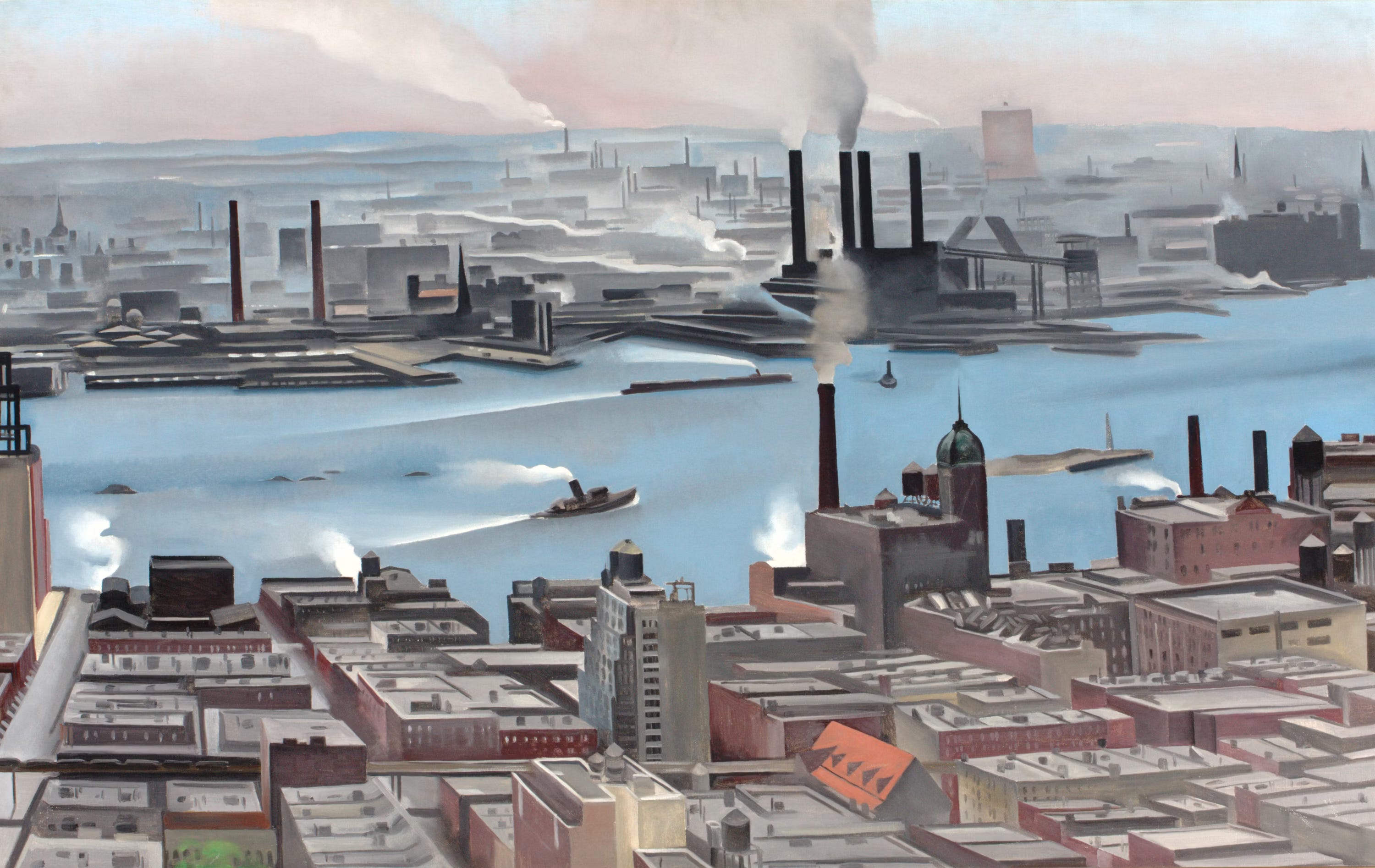
In 1924 (some records say 1925), Georgia O’Keeffe moved into the Shelton Hotel in New York together with her husband and photographer Alfred Stieglitz. The Shelton was one of the tallest hotels in the world at that time, and she had a unique opportunity to live on the 30th floor overlooking the city. It was those sweeping views of the growing metropolis that urged her to start painting New York City. As she recalls, “Of course, I was told that it was an impossible idea – even the men hadn’t done too well with it”. O’Keeffe was one of the first painters to successfully depict the glory of NYC. It was not an easy feat; the architecture was trailblazing, and nothing similar could be found in Europe (the capital of art at the time), and an appropriate way of painting it hadn’t been yet achieved. Painting the city required a commanding perspective, one that would allow one to seize, understand and then render the grandiose infrastructure, a trait that was deemed more masculine.
Georgia O’Keeffe’s paintings from her New York time differ from her most famous pieces, both in the colour palette, which is much darker and moodier, and the subject matter. The strong, tall buildings of steel, glass and concrete.
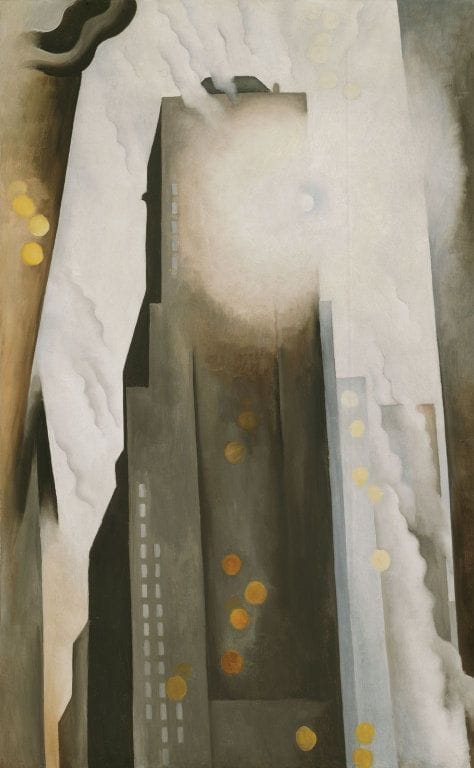
Her urban landscapes were often painted on narrow canvases that offer a panoramic view either vertically or horizontally of New York’s rapidly growing skyline. The Shelton with Sunspots (1926) is an incredible example of her masterful scenes from that time. It depicts the hotel she was staying at, brightly backlit by the sun that’s just barely breaking through from behind the monumental facade and bathing the foreground in its warm light. We find ourselves standing at the foot of the building, craning our necks, looking up into the sky, the rays of the sun washing over our face. The canvas is spotted with delicate light flares, amplifying the realism of the sun, unique and full of vitality.
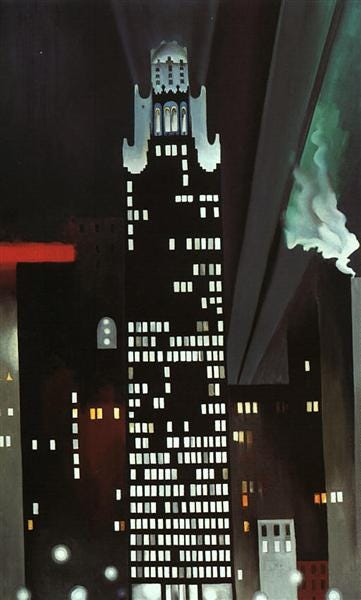
A lot of her paintings from that time, though, are of New York at night. The grand, glamorous skyscrapers standing tall, the city streets illuminated by cars, dozens of windows shining from within, the nightlife ensues. Bathed in the glowing moonlight, so often present in her paintings, this mysterious, new city comes alive on O’Keeffe’s canvases. The soaring structures fill up the entire frame, their size becomes their most appealing attribute.
Georgia O’Keeffe had her supporters, but a big chunk of the male art scene was not delighted with her new explorations. “The men decided they didn’t want me to paint New York. They told me to ‘leave New York to the men’. I was furious!” Stieglitz, among others, was of the opinion that the urban landscapes were too masculine for O’Keeffe. He expected her to bring femininity to her paintings. Later, when she painted her famed flowers, Stieglitz was instrumental in making the world view them as sexually potent and hyper-feminine. In fact, that was not at all Georgia’s aim, stating that “I’ll make them big, like the huge buildings going up. People will be startled; they will have to look at them.” Her flower paintings were interpreted as sexual for the most part due to having been exhibited next to Stieglitz’s nude photos of Georgia. He also directly spoke of them as such. As Stieglitz undeniably was a crucial part of O’Keeffe’s entering the art scene, he granted himself a lot of power over her artistic career and choices. He believed that her brand should be the feminine ideal. He is also said to have feared her rivalry and would interfere in her practice, discouraging her from different paths that she wanted to explore. He promoted her work in many exhibitions, yet he did not want to show her cityscapes.
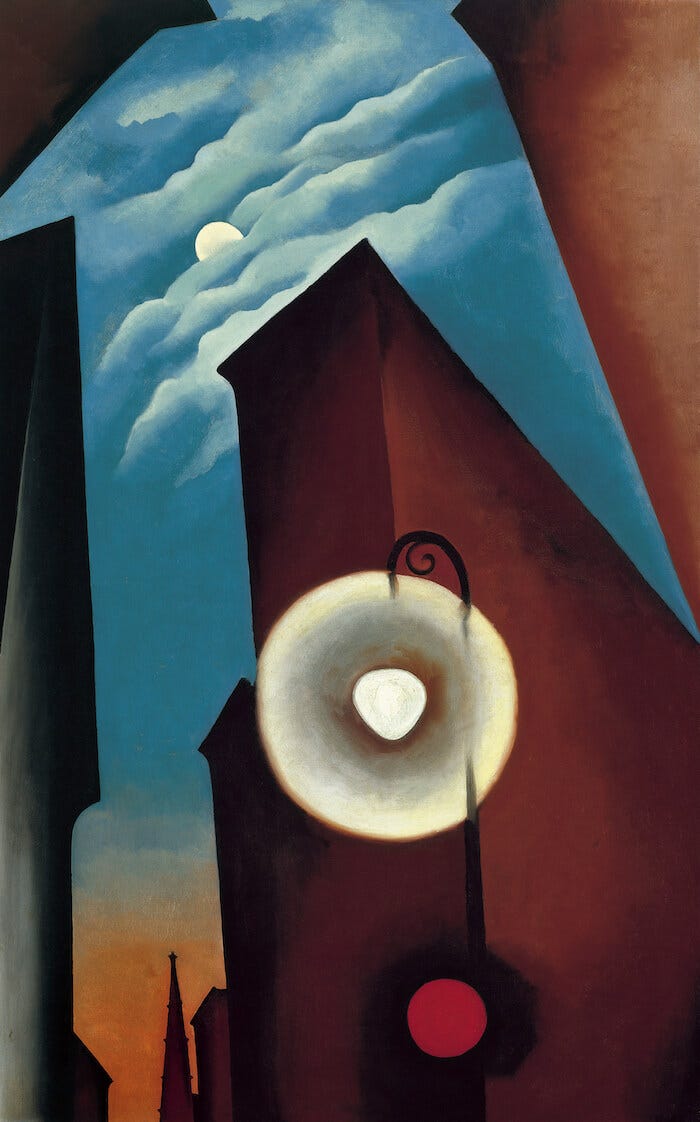
Her first major cityscape – New York Street with Moon (1925) – sold immediately after being exhibited.
It is disheartening how her paintings of New York were deemed too masculine by many, yet they were the crucial works that informed her later, so-called feminine flower pieces. Their wrongful interpretation was canonised, placing them as symbols of female sexuality. Even though she is mainly known for her organic forms and Mexican landscapes, it was in fact the city that shaped her style as well as her innovative perspective of a Modernist. Placing the cityscapes next to her later works truly allows the viewer to see what a consistent and coherent body of work she had made and how her distinctive style and visual language translate between different subject matters.
O’Keeffe’s 1926 exhibition, which put on display nine of her New York paintings, was described by the New Yorker as a “marvellous show of a genius which it would be foolish to miss.”
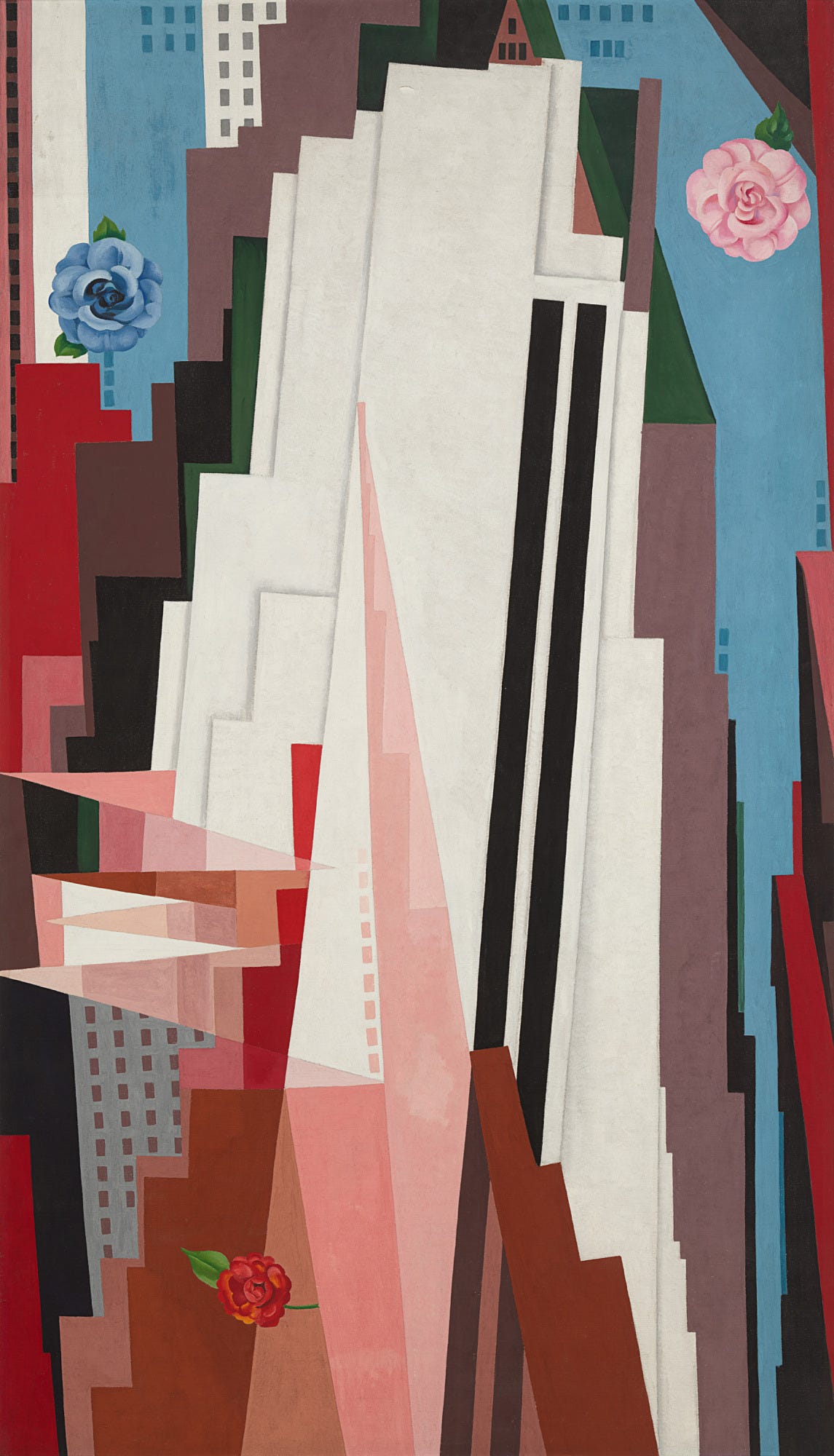
The artist herself believed that her paintings of the city included “probably my best paintings” that she hoped would “turn the world over”. However, unfortunately, her wish was not granted. She became remembered for her supposedly overtly feminine and sexual flower portraits, as it is too easy to draw a connection between women and sex, thanks to her husband, who marketed them that way, despite her protests and countless attempts at rectifying that claim. Yet if we take a moment to inform ourselves about Georgia O’Keeffe’s body of work, we will find how her depictions of the colossal skyscrapers influenced her perspective on the natural world and how she just wanted the flowers to be grand and overwhelming instead of womanly and reproductive.
ooh i didn’t know about these either!! thoroughly enjoyed this and love the pieces you included
You're right, I only knew and saw her flowers and Mexico work and that's it. Your piece made me love her even more. Great highlight, thanks !!